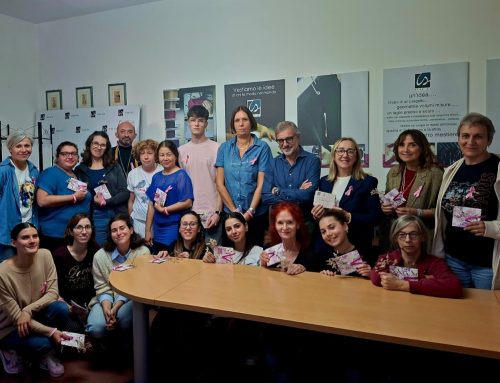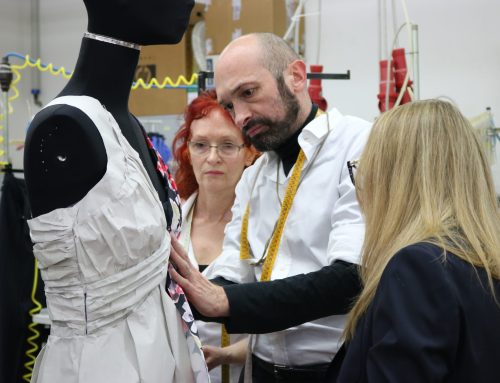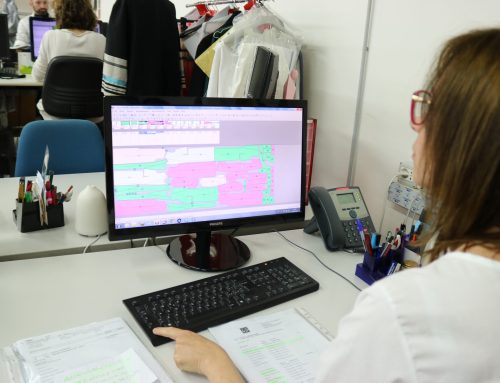

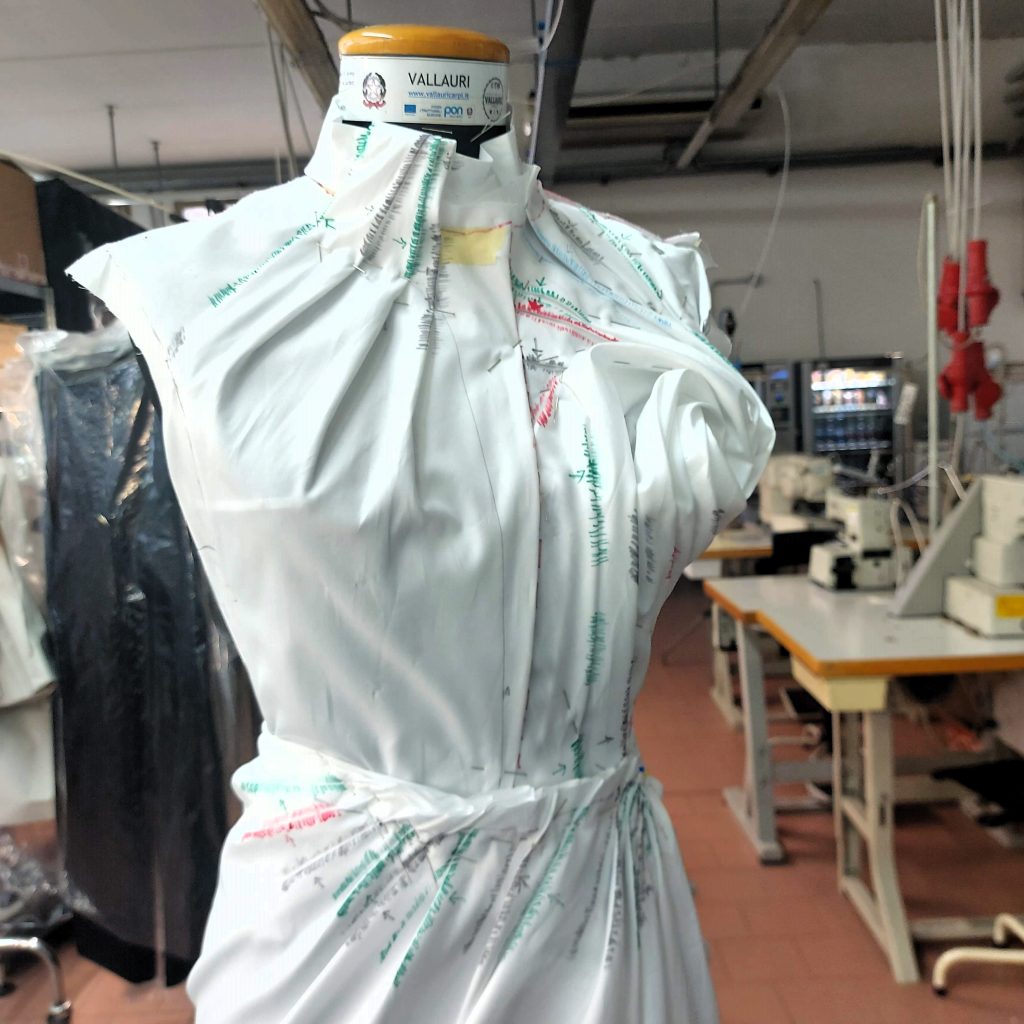
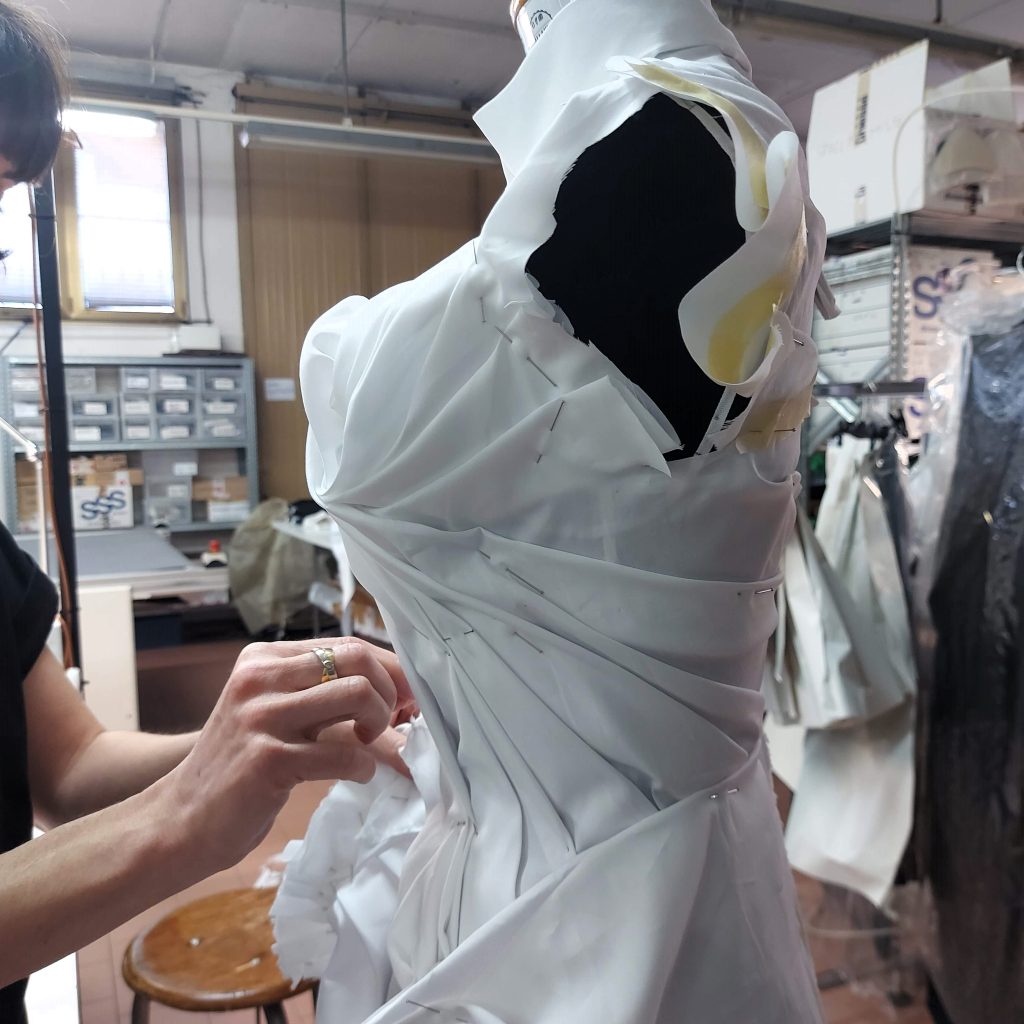
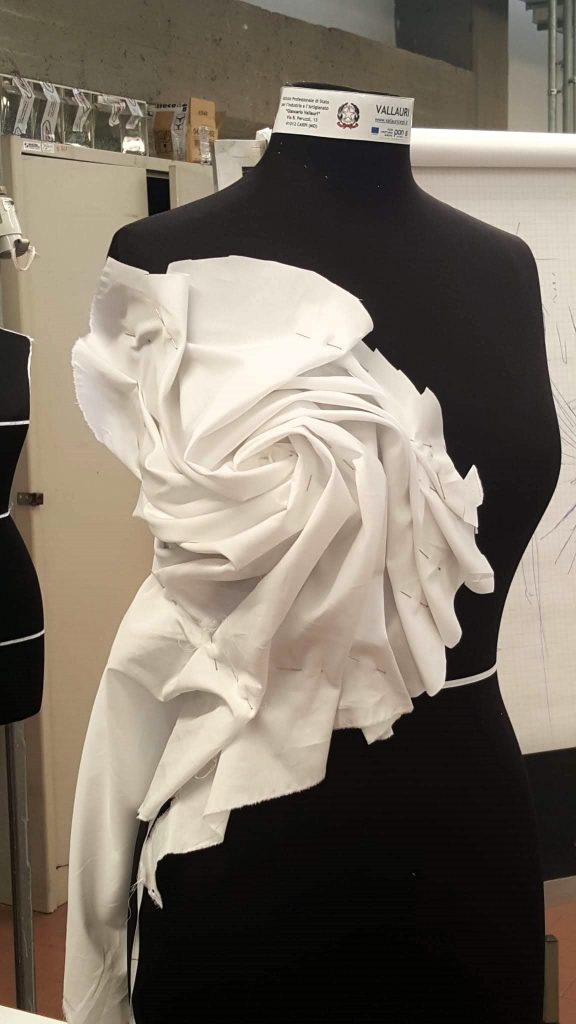
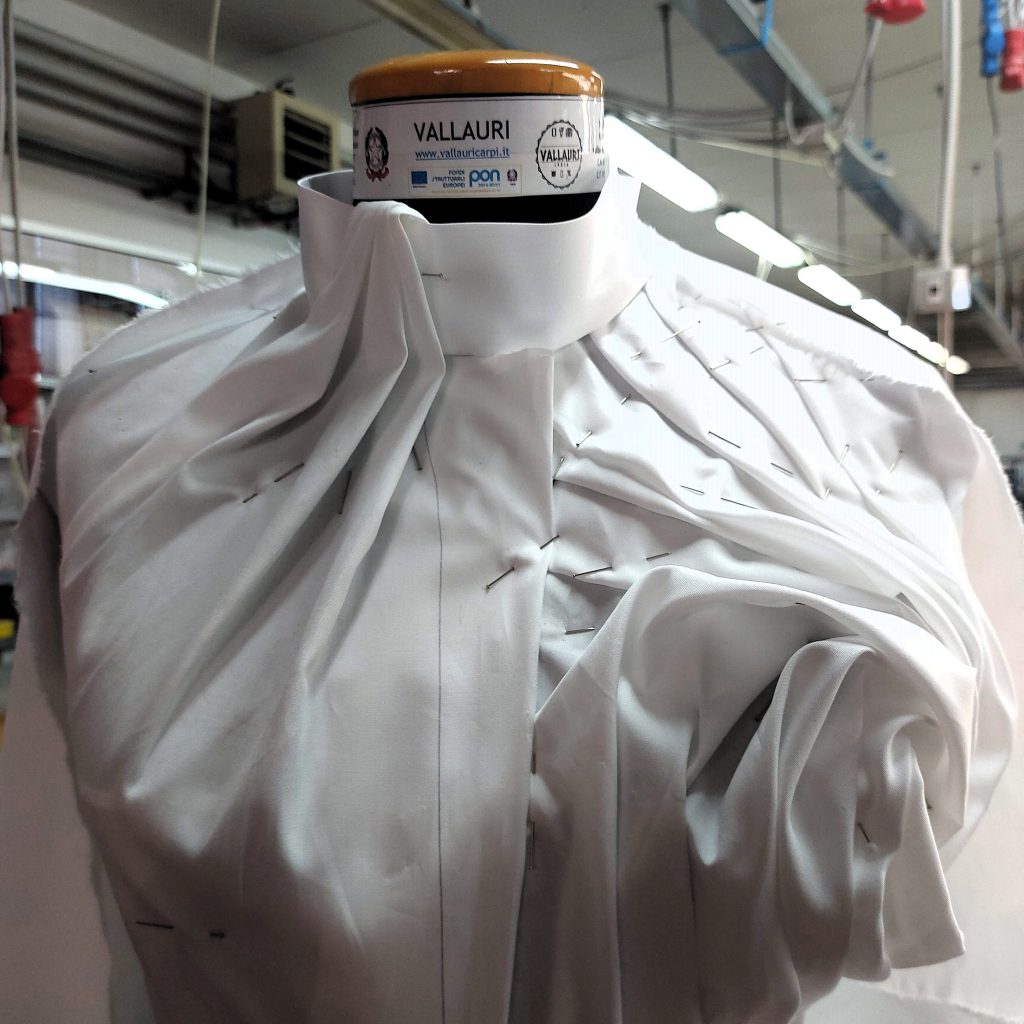
In 2023, Crea-Si’s pattern makers took part in a training course on the moulage technique. The course was led by Danilo Attardi at the I.P.S.I.A. Vallauri school in Carpi. It was a chance to get back to working by hand, directly on fabric and on the dress form, in the heart of our district.
In this article we explain why we chose to deepen this method. We then describe what moulage is, how it works and what benefits it brings to anyone developing a garment.
Why we chose to train in moulage
Every day we work with 2D and 3D pattern making. So why invest time in another technique? The answer is simple: the more methods you know, the more solutions you can offer.
Someone who masters several techniques chooses the one that suits the garment, not the one that is most convenient. Moulage widens that range, especially for designs with draping and unusual shapes.
The training also has value for our area. Taking it in Carpi, at a school in the district, strengthens the link between companies, education and technical skills.
What is the moulage technique
The term comes from the French moule, meaning form or mould. In English, the same technique is called draping.
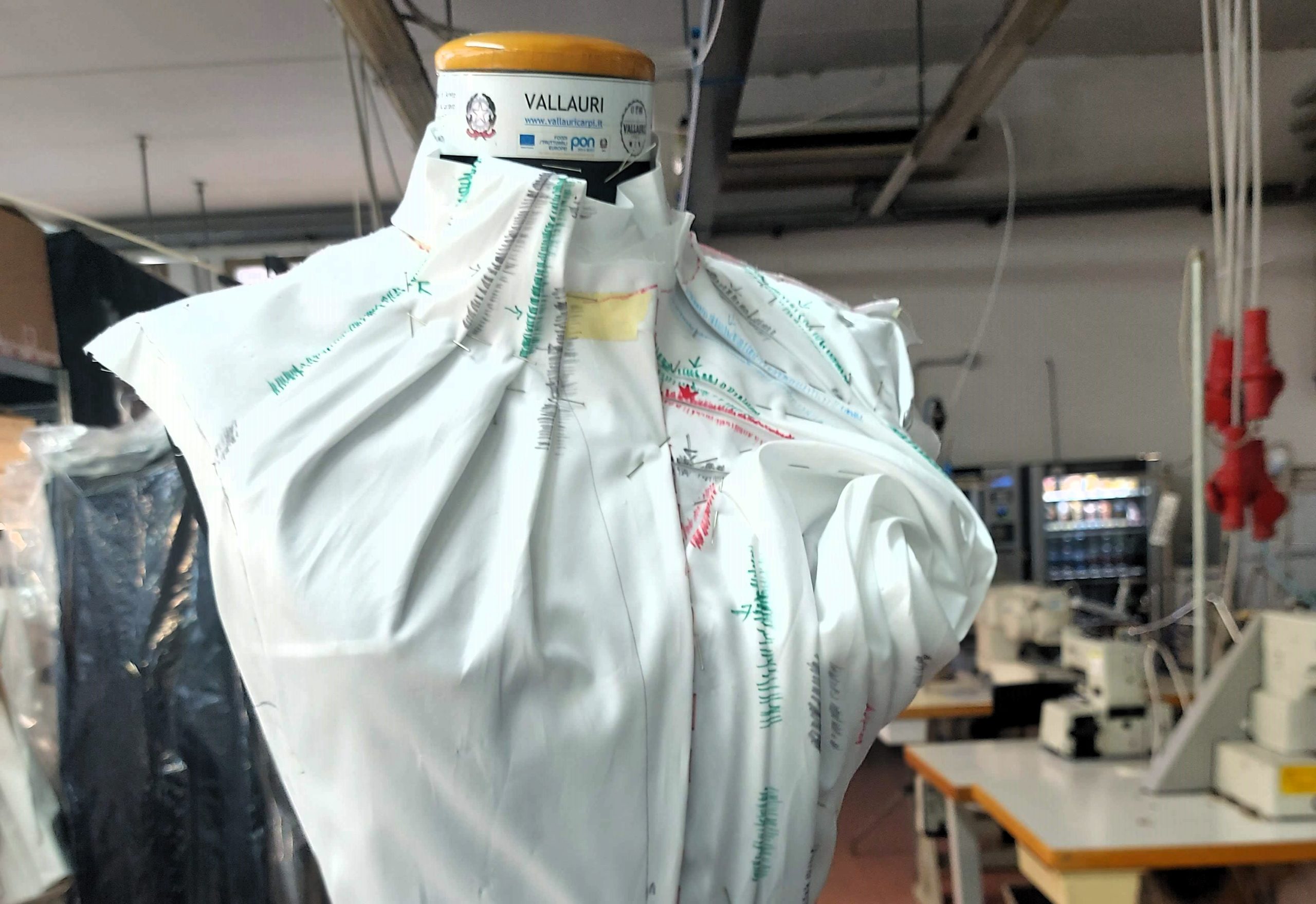
The principle is simple. The fabric is placed on a tailor’s dress form, shaped by hand and secured with pins. This way you immediately see how it falls, what volume it takes and what silhouette it creates.
It is a technique rooted in the history of European haute couture. Madeleine Vionnet, famous for the bias cut, is one of the figures most associated with this way of working. Today, moulage remains a valuable tool in product development.
How the moulage technique works, step by step
Every project has its own particulars. However, the process generally follows these stages:
- Design analysis. We start from the sketch or the technical sheet, to understand shape, volumes and details.
- Dress form preparation. Reference lines are marked, such as shoulders, waist and centre front.
- Draping the fabric. A test fabric is placed on the dress form and shaped.
- Pinning. Folds, necklines, volumes and seam lines are defined.
- Marking the lines. Key points are marked directly on the fabric.
- Transfer to paper. The pattern is drawn from the fabric, then refined.
- Prototype and fitting. The design is made up and checked for fit.
Moulage and flat pattern making: what are the differences
Flat pattern making builds the pattern on a flat surface, starting from measurements and drafting rules. Moulage, instead, starts from the body and from the fabric in motion.
The two methods are not in conflict. They often work together, because each offers different strengths.
- Flat pattern making: it is precise, repeatable and well suited to size grading and production.
- Moulage: it shows volume and drape immediately, and is quicker for complex shapes.
For this reason, depending on the garment, it can make sense to use one, the other or both.
The benefits of the moulage technique in pattern making
Learning moulage enriches the way we design. Here are the main benefits:
- Three-dimensional vision. You think in terms of volume, not only on paper.
- More solutions to evaluate. Different constructions can be compared before the prototype.
- Control over draping. The way the fabric falls is adjusted directly on the dress form.
- Knowledge of the fabric. You understand how it reacts to weight, folds and movement.
- Dialogue with the sewing room. Pattern makers and seamstresses speak the same language, right from the design stage.
- Fewer surprises in prototyping. Many issues emerge earlier, while the design can still be changed.
When to use the moulage technique
Moulage works best in specific cases:
- Draping and folds: the fall of the fabric is controlled by eye.
- Soft necklines and sculptural details: they are adjusted without guesswork.
- Unusual volumes: you see at once whether the shape works.
- Fluid fabrics: viscose, crêpe, jersey and silk behave in ways that are hard to predict on paper.
To learn more about the behaviour of fluid fabrics, read our guide to the characteristics of viscose.
What it means for those who entrust us with a project
If you have a garment with draping, special volumes or fluid fabrics, we can assess together the most suitable technique. Depending on the project, we can work with moulage, with flat pattern making or with 3D design.
The next step is prototyping, where the design becomes a real garment to try on. To find out how we work, visit the page on pattern design.
Frequently asked questions about the moulage technique
Are moulage and draping the same thing?
Yes, in practice they describe the same method. Draping is the English term, moulage the French one, more commonly used in Italy.
Is moulage only for haute couture?
No. It originated in haute couture, but it is useful in any project with shapes, draping or fabrics that require seeing the result in three dimensions.
Does moulage replace computer-based pattern making?
No. It works alongside other tools. A pattern created through moulage can then be digitised and graded into different sizes.
How do you go from moulage to a pattern?
The lines marked on the fabric are transferred to paper. The pattern is then refined, tested in a prototype and corrected if needed.
What fabric is used for moulage?
Generally you start with a test fabric to define the shape. The result is then checked with the real fabric of the garment, because every material drapes differently.
Conclusion
The moulage training has broadened our pattern makers’ skills. The moulage technique makes it possible to build a garment starting from volume and movement. This makes the translation of an idea into a real product more precise.
Do you have a project with draping or special shapes? Contact us to talk to our pattern makers. To explore more topics, visit our technical fashion guides and the article on how to recognise a high-quality garment.
About the Author: Crea-Si