
Every garment starts from an idea, but it’s in the prototyping stage that this idea has to prove it truly works. It’s the moment when the pattern, the fabric trials and any 3D simulations give way to the first physical garment: the one where, for the first time, all the details that on paper remained mere hypotheses can actually be seen.
This isn’t a step to take for granted. A garment can look perfect at the design stage and, once assembled, reveal fit issues, unexpected fabric drape or seams that can’t support the intended structure.
For this reason, prototyping shouldn’t be seen as a simple production step, but as the project’s first real test.
Work built on materials, not just technique
Working on a prototype means dealing with very different materials: silks and laces that require extreme delicacy, and cottons and denim that instead need structure and precise cutting.
Every fabric behaves differently under needle and scissors, and the ability to choose the right technique for each material is what sets a well-executed prototype apart from an approximate one.
Knowing how to assemble the pieces isn’t enough: it takes the sensitivity to understand how that particular fabric will react, how it will drape and how it will behave at the garment’s critical points.
The collaboration between the pattern maker and the prototype seamstress
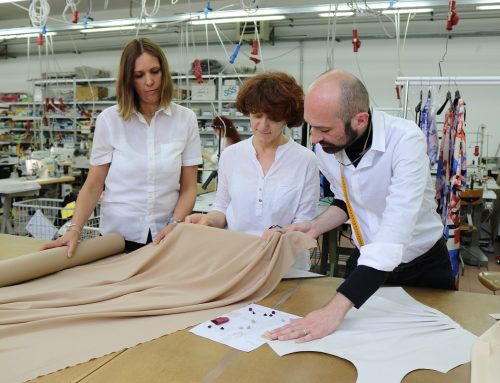
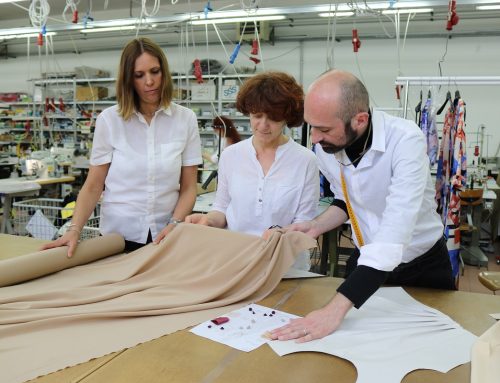
Behind a successful prototype there’s almost always teamwork. The pattern maker passes on all the necessary technical information, including pattern details, cutting constraints and known fabric issues, while the prototype seamstress interprets these instructions and defines the most suitable working sequence to achieve a precise result.
This ongoing exchange makes it possible to identify any problems straight away, rather than discovering them only once the garment is finished, and it’s particularly valuable for correctly developing a fashion collection.
The main stages of prototyping
The path from pattern to first wearable garment usually follows a few key steps:
- Fabric preparation, with steaming when needed to stabilise measurements and reduce material shrinkage before cutting.
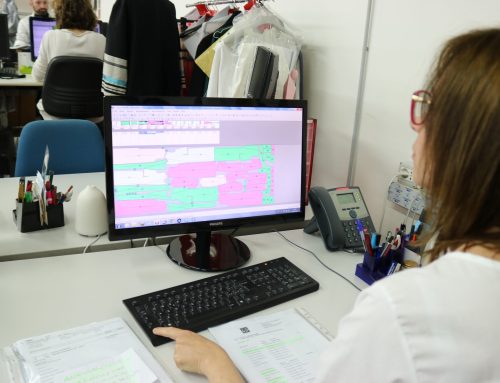
- Checking cutting guidelines, essential when working with placed prints, stripes or checks that need to match up at precise points.
- Defining the working sequence, decided according to the specific characteristics of the chosen fabric.
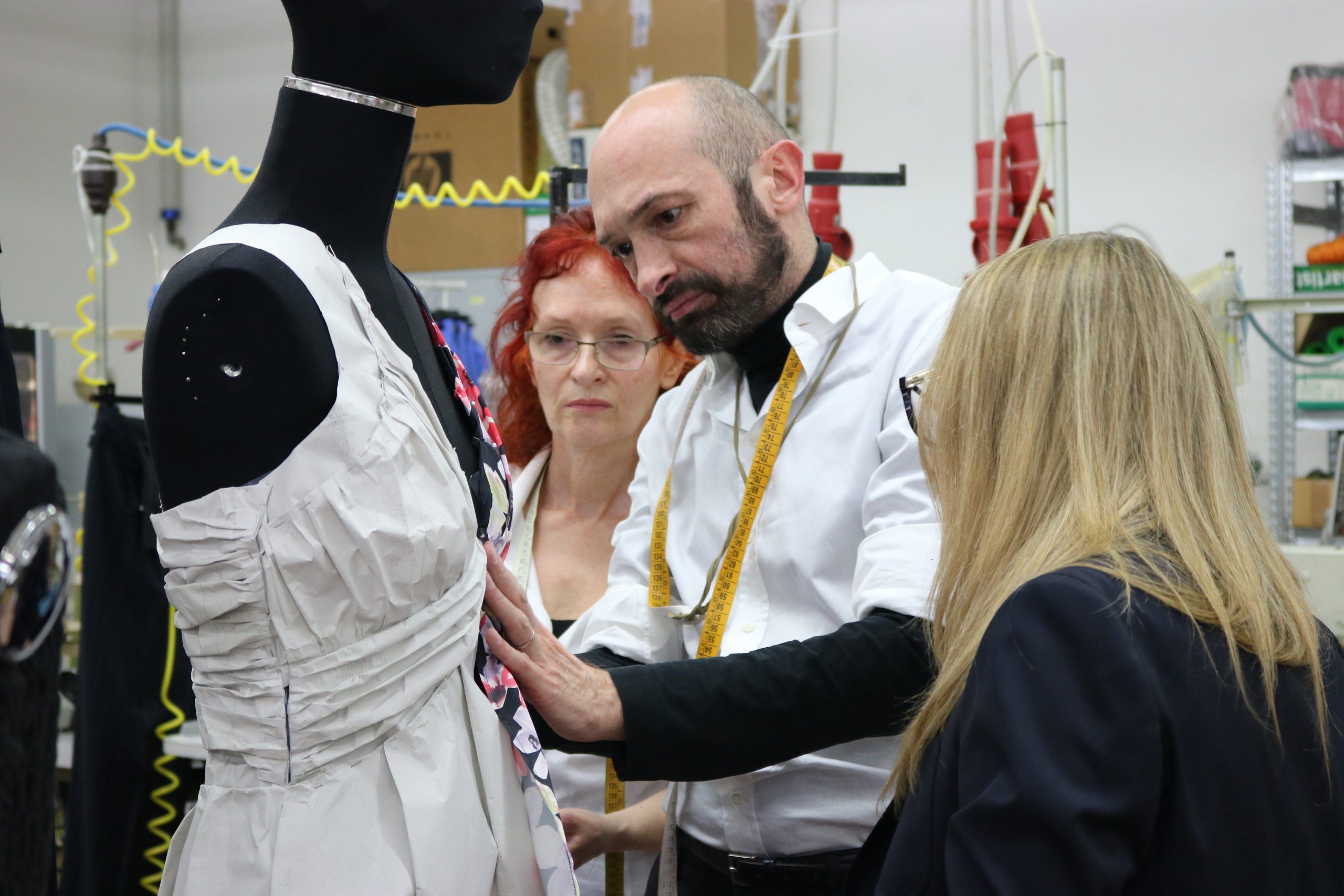
- Fittings on a mannequin, repeated several times during the process to check volumes, symmetry and proportions.
- Ongoing quality control, present at every stage rather than only at the final result.
- Final check, with a complete review of measurements and details before the prototype is handed over for fitting.
Why it’s worth investing in a well-made prototype
A carefully made prototype isn’t a cost, but an investment that avoids far more expensive mistakes later on: reworking, wasted fabric, delays in production.
It’s the tool that makes it possible to actually verify whether the proportions work, whether the material behaves as expected and whether the finished garment truly reflects the stylist’s original idea.
For those developing structured collections or garments with complex processes, solid prototyping is the foundation on which a reliable sample collection, and consequently a quality production, can be built.
Want to create the prototype for your fashion collection?
Contact Crea-Si to discuss your project together with our artisans.
About the Author: Crea-Si